Initialising NeuralMesh...
0%
0%
QuantumSecure
Technologies.
Home
About
Mission
Crypto
Tech
Aeon-Σ
Chimera QC1
QA-1
Roadmap
Journal
Contact

Quantum
Hardened
Security

Defence Against Tomorrow, Standardised Today.

System Status: NIST PQC Ready
Kyber-768,
Dilithium3
UK Silicon
Legacy encryption is rapidly becoming obsolete.
We seamlessly integrate agentic AI, biological-scale spiking neural networks, and post-quantum cryptography to safeguard digital assets.

( The Vulnerability )

Most digital systems today are built on an assumption that no longer holds.
They assume trust.

Vulnerability Map

We're entering an era where attacks move faster than human response, where artificial intelligence accelerates exploitation, and where quantum computing threatens the cryptographic foundations of the internet.

Breaches are no longer anomalies. They're an expected outcome of how systems are designed. Security should be enforced cryptographically, continuously, and by default.

01 Our Mission

True security is a fundamental right, not a privilege.

QuantumSecure Technologies Ltd is a Birmingham-based startup on a mission to democratise elite cybersecurity. We believe that true, hardened security shouldn't be a privilege reserved exclusively for massive corporations — it's a right that everyone should be entitled to.

So to change this, we design custom silicon and resilient security architectures that blend agentic AI with post-quantum cryptography. Our goal is simple: to ensure your critical systems can autonomously think, adapt and defend themselves against emerging threats. We bring you the advanced, self-protecting defence architecture.

/ 01 · HARDEN

Custom Silicon

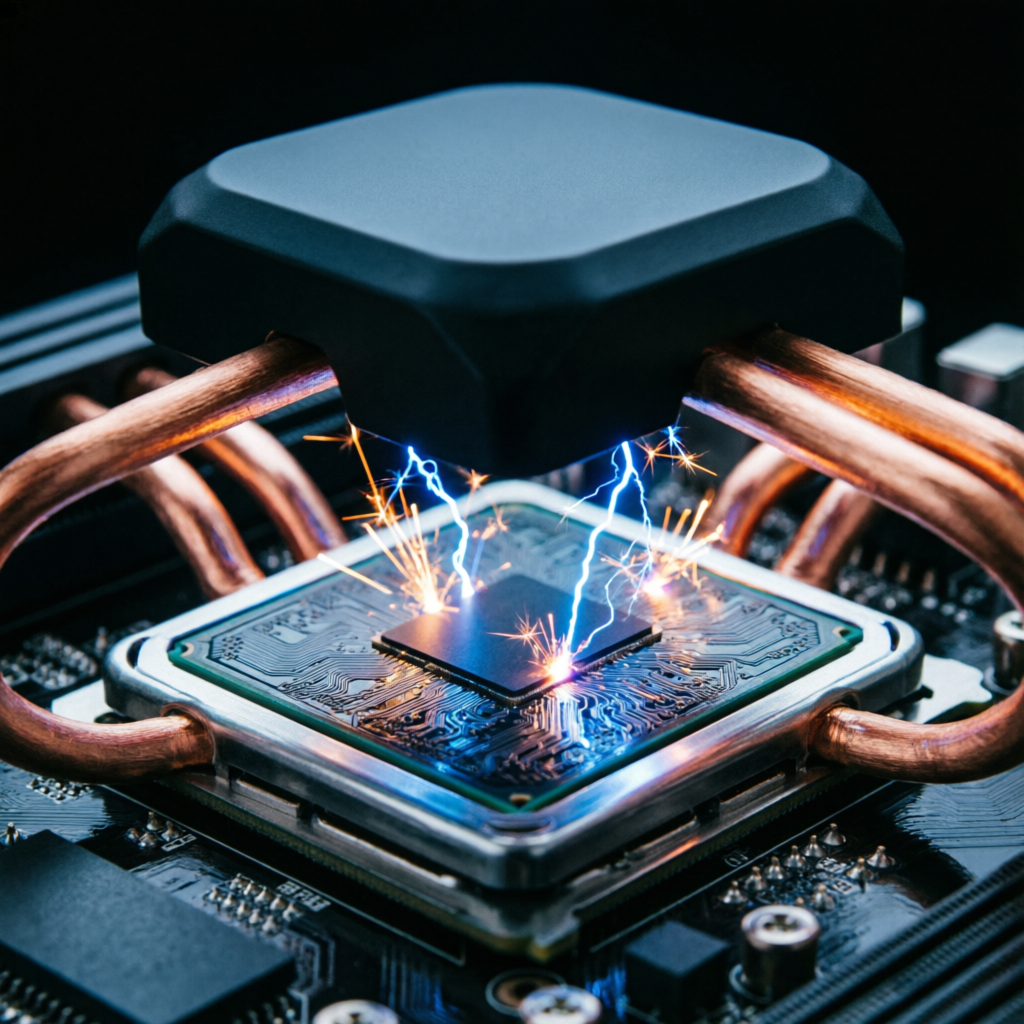
UK-designed neuromorphic processors built for cryptographic enforcement at the hardware boundary.

/ 02 · ARM

Autonomous Defence

Agentic AI and biological-scale spiking networks that adapt to threats without human intervention.

/ 03 · ENDURE

Post-Quantum Crypto

Physics-based cryptography engineered to withstand harvest-now, decrypt-later adversaries.

Quantum-Hardened Security for the Systems That Matter

Mathematical
Precision.

Eliminating the performance penalty of quantum safety. Built from first principles using quaternion algebra and chaos theory.

Module 01

NeuralSeal
v3.2 Fulminis

Military-grade, post-quantum cryptographic library built entirely in C11. Pure quaternion-chaos architecture.

Quantum Security Level256-bit (NIST L5)
KEM Key Generation0.47µs
Public Key Size256 bytes
Latency0.22µs

Module 02

HyperCycle
Vortex v2.0

Vacuum-based post-quantum cryptography. Reimagines entropy generation by simulating chaotic electromagnetic field fluctuations.

L_HE = (α²h²/90mc²)[(E²-B²)²+7(E·B)²]
Throughput1.05B ops/sec
AVX-512 Batch0.010 µs
Entropy EngineSkew Tent Map

Security at the
Chiplet Level.

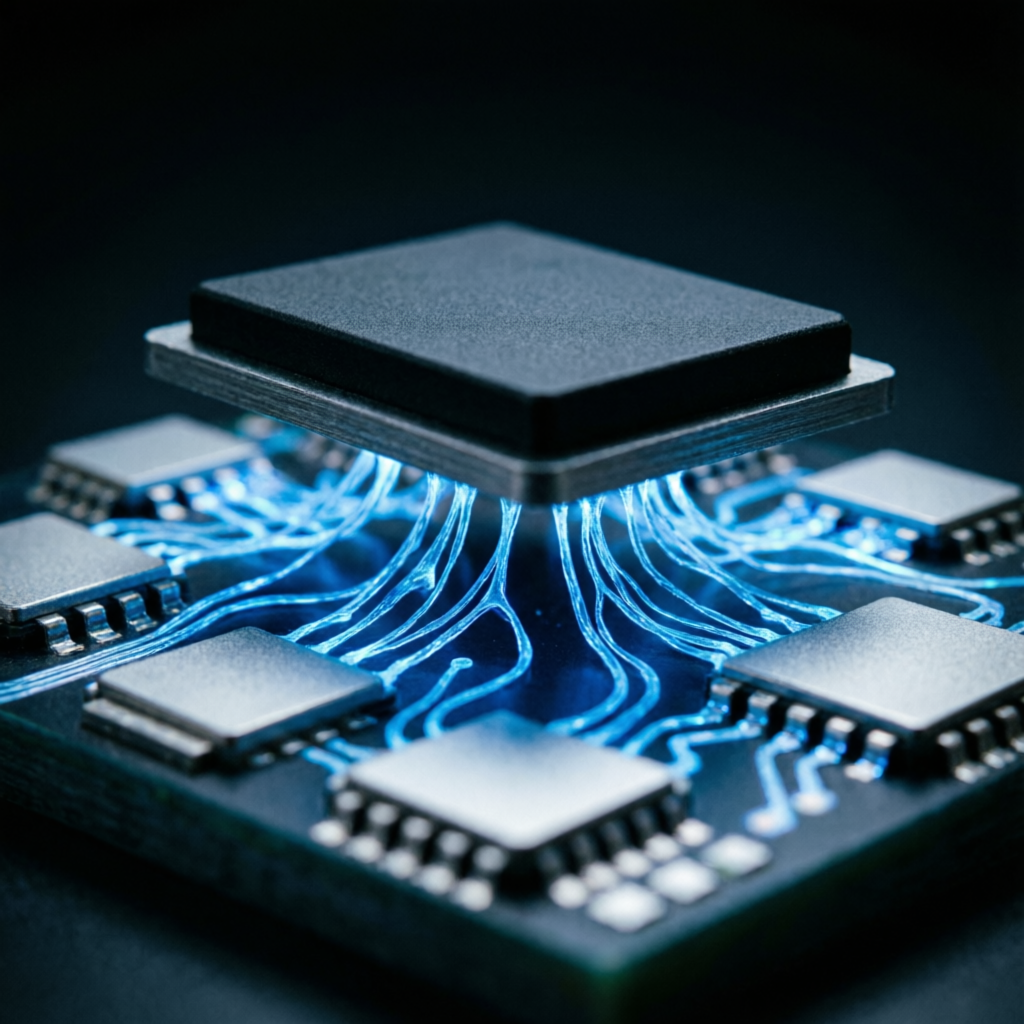
Synapse doesn't patch security onto existing silicon. It disaggregates it. We move the security boundary from a software permission to a physical chasm using a Secure Die-to-Die Interface.

Synapse Architecture
  • Sovereign Silicon
    UK Designed and Fabricated
  • Hardware Domain Separation
    Physical chasm between logic and memory
  • Active Shielding
    Zeroisation upon physical tamper detection

Analogue GST Memory

Non-volatile, radiation-hardened memory.

SECURE D2D INTERFACE

Digital Logic Core

SNN inference engine and PQ acceleration.

02 The Cortex Neuromorphic Processor

Bring Biological Efficiency
to the Edge.

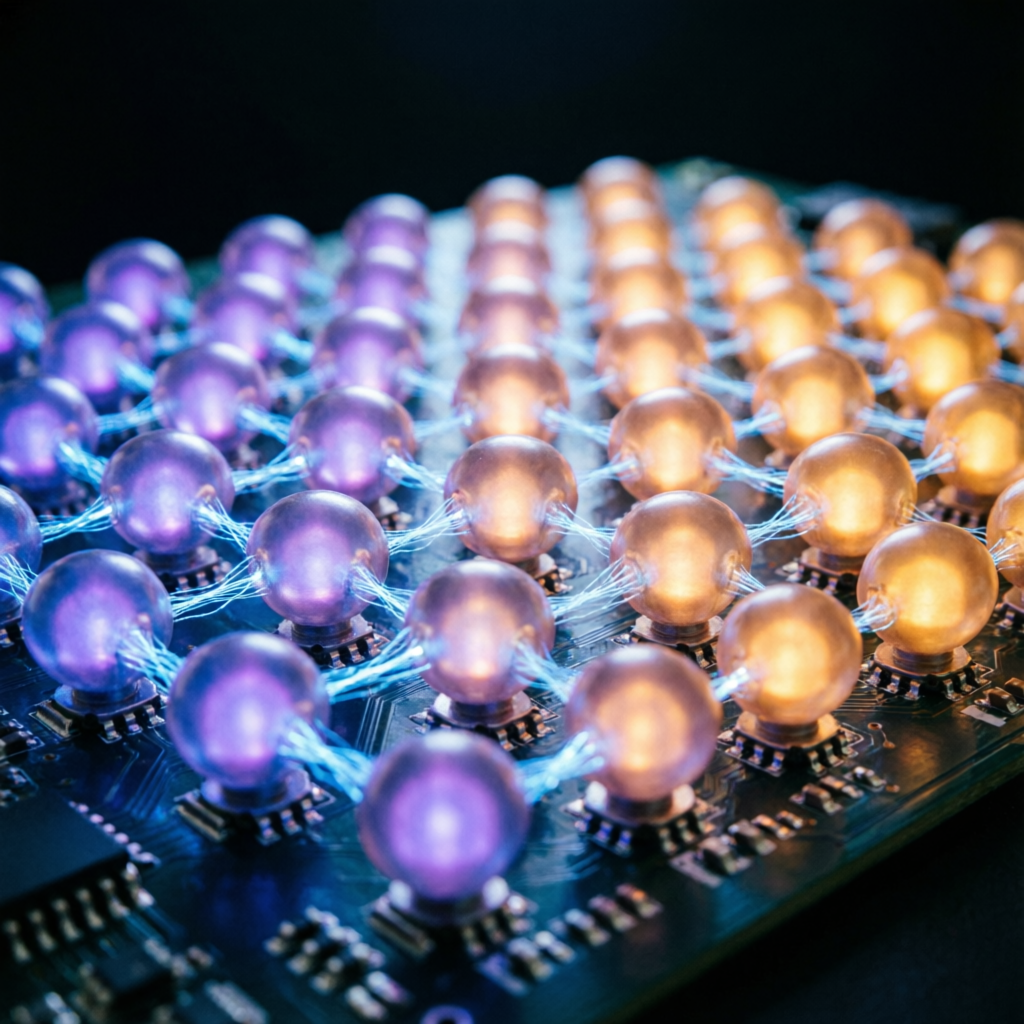
The Cortex Neuromorphic Processor is our proprietary, UK-designed custom silicon. Instead of brute-forcing computations like a traditional processor, Cortex uses spiking neural networks to process complex security anomalies with the extreme, low-power efficiency of a biological brain.

Because threats evolve constantly, Cortex continuously learns the natural behaviour of your network, allowing it to identify unrecognised threat patterns in milliseconds.

To guarantee maximum protection without sacrificing speed, we disaggregate our security functions across two dedicated chiplets. A GST phase-change memory chiplet securely locks away your cryptographic keys, while a separate digital logic chiplet handles post-quantum acceleration and neural network inference. The result? Security that is built-in, always-on, and never treated as an afterthought. With Cortex, you get biological power efficiency, silicon-level learning, and quantum-hard cryptography combined right at the core.

Analogue GST Memory Chiplet

Phase-Change · Cryptographic Key Vault

Secure D2D Interface

Digital Logic Chiplet

SNN Inference · PQ Acceleration

<500mW
Always-On TDP
2Mneurons
Asynchronous Cores
~msresponse
Anomaly Detection

03 The Synapse Platform

Composable Chiplet Architecture for Zero-Trust Post Quantum Security.

Unified by design. Flexible by intent.

True zero-trust demands more than sophisticated software it requires an unbreakable physical anchor forged directly into the silicon. Currently in development, the Synapse platform is being engineered to deliver exactly that: a revolutionary chiplet architecture featuring 25 custom-designed chiplets built to operate as a unified whole or in any custom combination you choose.

Each chiplet is purpose-built to work seamlessly with the others forming a complete, impenetrable security ecosystem when deployed together. But Synapse is being designed as a composable platform, not a rigid one. Need full-spectrum protection? Activate all 25. Need targeted security for a specific workload or threat surface? Select only the chiplets that fit. The platform is being architected to adapt to your environment not the other way around.

Paired with a rigorously hardened Windows driver stack, Synapse is being built to create an immovable foundation for the most critical infrastructure. Post-quantum protection isn't being treated as a bolted-on afterthought. It's being etched into the silicon from chiplet design through final integration a deliberate, ground-up architecture designed to eliminate single points of failure.

C-01
C-02
C-03
C-04
C-05
C-06
C-07
C-08
C-09
C-10
C-11
C-12
C-13
C-14
C-15
C-16
C-17
C-18
C-19
C-20
C-21
C-22
C-23
C-24
C-25
Active (25)
Targeted Set
Standby
Σ
Project Aeon-Σ

( Project Aeon-Σ )

Thermodynamically
Aware.

Project Aeon-Σ represents a fundamental paradigm shift in how quantum systems manage decoherence. Controlled chaos can be used to stabilise quantum states, bypassing the 1,000:1 overhead of conventional error correction.

/ 01
Scientific Boldness
Actively nullify entropy before it corrupts qubits.
/ 02
Thermodynamic Elegance
Heat and information management as physics.
/ 03
Sovereign Innovation
Fully UK-qualified supply chain.
/ 04
Modular Openness
Drop-in control subsystem.
Explore Aeon-Σ →

The Vision

Uncompromising security that flows unbroken through every layer of your system, with the flexibility to scale, reconfigure, and evolve alongside your operational needs.

One platform. Any configuration. Zero compromise.

Disclaimer: Synapse is currently in development and not yet available for deployment.

( NeuralMesh Interactive )

Live Threat Analysis.

Query our specialised AI agent to evaluate hypothetical attack vectors against your infrastructure. NeuralMesh simulates state-sponsored and post-quantum threat scenarios in real-time.

NeuralMesh v4.0.1 // Secured Link INITIALISING WEBGPU...
> SYSTEM INITIALISED...
> SECURE CONNECTION ESTABLISHED.
>

Adapt.
Defend.
Evolve.

QuantumSecure Partner Network System Status
Home About Mission Cryptography Technology Aeon-Σ Chimera QC1 QA-1 Results Roadmap Journal Contact
Privacy Policy Terms & Conditions Cookie Policy
© 2026 QUANTUMSECURE TECHNOLOGIES LTD.
BIRMINGHAM, UK · INC. AUG 2025
Registered Company Name: QuantumSecure Technologies Ltd. | Registered Office Address: Birmingham, England, B18 4ND
Company Registration Number: 16627523 | Place of Registration: England and Wales

( 01 / About )

The Digital
Immune System.

Security is a fundamental right, not a luxury commodity. We blend AI, cybersecurity, and blockchain into a seamless framework that makes enterprise-grade protection accessible to everyone.

02 Core Philosophy

Most modern systems rely on brittle assumptions of trust.

We operate differently. Privacy by Design, Zero-Trust Architecture, Post-Quantum Readiness, and User Empowerment are at the heart of all we do.

Our technology protects privacy, employs decentralized identity, is resilient against quantum threats, and puts control in the hands of users and developers.

Philosophy
03 What We Stand For

Four pillars. One mission.

/ 01

Privacy by Design

Privacy is not an add-on. It is the foundational principle of every system we build, embedded from silicon to software.

/ 02

Zero-Trust Architecture

Trust is a vulnerability. We operate on cryptographic verification, never on assumed trust or compliance checklists.

/ 03

Post-Quantum Readiness

Every component is designed to withstand quantum-capable adversaries, today and for decades to come.

/ 04

User Empowerment

Non-custodial wallets, developer utilities, and sovereign control put power back in the hands of users.

Company Mark
04 The NeuralMesh Stack

A vertically integrated security and computation stack.

NeuralMesh is designed to replace implicit trust with cryptographic verification. From our post-quantum cryptographic libraries (NeuralSeal and HyperCycle), to our secure wallet, AI-powered detection, a security-first blockchain, continuous immune response, and the secure Fusion Programming Language, each layer is built to work together for uncompromising protection.

Team
05 The Company

Quietly ambitious. Engineering-led.

QuantumSecure Technologies is a UK-based security firm incorporated on 4 August 2025 and based in Birmingham, shaping the Digital Immune System that makes enterprise-grade cybersecurity accessible to all.

We are skeptical of existing systems, precise and uncompromising in security. Quietly ambitious, engineering-led, and committed to being correct rather than trendy.

/01

Trust Is a Vulnerability

If a system requires trust, it is already flawed.

/02

Built From the Ground Up

Security engineered in, not bolted on as an afterthought.

/03

Sovereign and Independent

UK-designed silicon. UK supply chain. Full sovereign control.

06 Contact

Let us build something impenetrable.

info@quantumsecuretechnologies.co.uk
Home About Mission Cryptography Technology Aeon-Σ Chimera QC1 QA-1 Results Roadmap Journal Contact
Privacy Policy Terms & Conditions Cookie Policy
© 2026 QUANTUMSECURE TECHNOLOGIES LTD.
BIRMINGHAM, UK · INC. AUG 2025
Registered Company Name: QuantumSecure Technologies Ltd. | Registered Office Address: Birmingham, England, B18 4ND
Company Registration Number: 16627523 | Place of Registration: England and Wales

( 01 / Manifesto )

Security is a
Fundamental Digital Right.

QuantumSecure Technologies is built on the principle that security should be accessible and dependable for everyone, enabling individuals, teams, and organisations to safeguard their digital assets without resource or skill constraints.

The Digital Immune System defends quietly.

Too often, breaches occur not from negligence but from a history of protection being complex, costly, and exclusive.

We believe security should be as natural and unobtrusive as an immune system. Our Digital Immune System combines AI-native detection, post-quantum cryptography, and decentralised architectures to make resilient, modern security broadly accessible.

It defends quietly: observing behaviour, remembering truth with tamper-evident cryptography, and sharing collective protection across networks with no single point of failure.

Practical, result-oriented engineering drives our tools, they are built to solve real vulnerabilities, tested against live threats, and refined for actionable, reliable, usable protection that just works.

02 Core Principles

Four principles. One mission.

01

Quiet, Effective Defence

Security should work quietly in the background, like an immune system, frictionless for users and an obstacle for attackers.

02

Practical, Result-Oriented Engineering

We focus on real-world outcomes, not hype. Every tool is built to address actual vulnerabilities, tested against real threats, and refined with experience.

03

Accessible for Everyone

Enterprise-grade defence should not be reserved for large budgets or elite teams. Our immune system scales through intelligent architecture, collective learning, and practical deployment.

04

Empowering the Individual

Zero-trust designs, non-custodial wallets, and developer utilities like Fusion give true ownership and control to users, removing reliance on any single authority.

Flagship Products
03 The Bottom Line

QuantumSecure rejects a world where security is a privilege.

Privacy and security must be the default for everyone, not a luxury gained through complexity or high cost. By uniting AI, advanced cryptography, and decentralised architecture, we are building a truly private, accessible, and quantum-secure digital future for all, one intelligent and quiet layer at a time.

04 Contact

Join the mission.

info@quantumsecuretechnologies.co.uk
Home About Mission Cryptography Technology Aeon-Σ Chimera QC1 QA-1 Results Roadmap Journal Contact
Privacy Policy Terms & Conditions Cookie Policy
© 2026 QUANTUMSECURE TECHNOLOGIES LTD.
BIRMINGHAM, UK · INC. AUG 2025
Registered Company Name: QuantumSecure Technologies Ltd. | Registered Office Address: Birmingham, England, B18 4ND
Company Registration Number: 16627523 | Place of Registration: England and Wales
( 01 / Cryptography )

Mathematical Precision.
Unbreakable.

We eliminate the performance penalty of quantum safety by building from first principles using quaternion algebra and chaos theory cryptography built on physics that does not change.

NeuralSeal v3.2
HyperCycle v2.0
NIST Level 4 Equivalent
02 NEURALSEAL DEEP DIVE

NeuralSeal v3.2 Fulminis.

NeuralSeal is a military-grade, post-quantum cryptographic library built entirely in C11. It replaces slow, bulky lattice-based cryptography with pure mathematical elegance.

NeuralSeal v3.2 Fulminis achieves 256-bit quantum security, equivalent to NIST Level 4 Equivalent, through a pure quaternion-chaos architecture leveraging two foundational hard problems: the Quaternion Conjugate Problem and the Chaos Inversion Problem.

Validated at 100 billion operations per day in production. External audit by Trail of Bits scheduled Q2 2026.

NeuralSeal abstract quantum cryptography crystal
03 KEY PERFORMANCE METRICS

Benchmarks that speak.

0.027ms
KEM Key Generation
37,037 ops/sec
0.019ms
KEM Encapsulation
Sub-microsecond domain
0.22µs
KEM Decapsulation
DSA Sign: 0.28µs
256-bit
Quantum Security
NIST Level 4 Equivalent equivalent
Public Key Size
256 bytes
6.1× smaller than NIST ML-KEM-1024
Secret Key Size
512 bytes
6.2× smaller than lattice equivalents
04 VERSION EVOLUTION

From Legacy to Fulminis.

v1.0
Legacy
20ms · 12KB · 128-bit
v2.0
Core
0.001ms · 64B · 128-bit
v3.0
Immovable
0.218ms · 96B · 128-bit
v3.1
Velocitas
0.042ms · 96B · 128-bit
v3.2 · CURRENT
Fulminis
0.027ms · 256B/512B · 256-bit

ARCHITECTURE: Pure quaternion-chaos · No lattices

HyperCycle abstract electromagnetic chaos torus
05 HYPERCYCLE VACUUM ENTROPY

HyperCycle.

HyperCycle is the world's first vacuum-based post-quantum cryptography platform. It fundamentally reimagines how cryptographic systems generate entropy by simulating the chaotic electromagnetic field fluctuations described by quantum electrodynamics.

It is a decentralized cryptographic suite for secure peer-to-peer AI collaboration, developed across three core versions each pushing the boundary of what is possible in cryptographic entropy generation.

06 THE HEISENBERG-EULER LAGRANGIAN

The physics that does not change.

LHE = (α²ℏ⁴ / 90mₑ⁴c⁷) [ (E² − B²)² + 7(E·B)² ]

After 47 iterations of chaotic field evolution, a single-bit difference in the initial state produces keys 87% different, demonstrating true chaos. Achieves 532× performance improvements over standard ML-KEM implementations and reduces key sizes by up to 49×.

07 HYPERCYCLE EVOLUTION

Genesis · Origin · Vortex.

v1.0 · GENESIS
Genesis
0.42ms · 1184B · 256-bit

Physics-based PQC debut. Ultra-optimized lattice. 1024-bit HyperKEM-1024. Key generation in <47 cycles (0.42μs).

v1.1 · ORIGIN
Origin
0.35ms · 1568B · 256-bit

Symplectic Integrator for Hamiltonian vacuum. Mathematical stability. GPU acceleration (765 MB/s throughput).

v2.0 · VORTEX · CURRENT
Vortex
<10 ns · 1568B · 256-bit

Skew Tent Map entropy. 4096-slot ring buffer for <10ns latency. Three-Tier AER for 100% reliability.

Reservoir
Zero-Latency
Recovery
Three-Tier
Sovereignty
Algorithmic
Certified
NIST SP 800-90B
08 HYPERCYCLE ROADMAP

Forward trajectory.

Near-term · Q2 2026

v2.1 Singularity

FPGA implementation of Skew Tent Map. Direct DMA entropy reservoir. Extended tests: Von Neumann entropy, autocorrelation, and spectral analysis. Multi-source entropy: RDRAND, environmental noise, and network jitter.

Longer-term · Q4 2026

v3.0 Multiverse

Quantum-entangled mesh networking. Distributed entropy generation and homomorphic encryption integration. Zero-knowledge proof support.

Ongoing

HyperSilicon

FPGA/ASIC IP core licensing, hardware-accelerated Hamiltonian evolution, and FIPS 140-3 Level 3 certification.

09 FLAGSHIP PRODUCTS

HyperCycle Platforms & NeuralSeal Libraries.

HyperCycle and NeuralSeal are flagship products from QuantumSecure Technologies Ltd, delivering high-performance, physics-based post-quantum cryptography (PQC).

HyperCycle Suite.

Decentralized cryptographic suite for secure peer-to-peer AI collaboration, developed across three core versions:

  • ·Genesis (v1.0) — Debuted physics-based PQC with an ultra-optimized lattice, vacuum entropy engine, 1024-bit HyperKEM-1024, and achieved key generation in <47 cycles (0.42μs).
  • ·Origin (v1.1) — Added a Symplectic Integrator for Hamiltonian vacuum, supporting mathematical stability and GPU acceleration (765 MB/s throughput).
  • ·Vortex (v2.0) — Introduces a Skew Tent Map for entropy, a 4096-slot ring buffer for <10ns latency, and a Three-Tier AER (Automatic Error Recovery) for 100% reliability.

NeuralSeal Stack.

Military-grade, C11 cryptographic library built on quaternion-chaos mathematics (no lattices). Modules include:

  • ·CQC Core — Chaotic geometric algebra and entropy.
  • ·Weave-KEM — Native, lattice-free, 256-bit quantum security, 8× smaller keys than NIST.
  • ·Weave-DSA — ZK-PoK signature scheme.
  • ·ML-KEM & ML-DSA — API-compatible Kyber/Dilithium drop-ins.
NeuralSeal

NS · MILITARY-GRADE

Throughput
>1B
operations/second GPU-batch
Efficiency
24B
public keys · 65× smaller than ML-KEM-1024
Latency
0.080µs
HyperCycle Vortex engine
Cryptography
10 BENCHMARK ANALYSIS

NeuralSeal & HyperCycle Performance.

The latest benchmarks show NeuralSeal and HyperCycle span from embedded CPU modes to billion-ops-per-second GPU batches, achieving generation-on-generation speed-ups. All benchmarks were performed on an AMD Ryzen 7 7840HS (Zen 4), with NVIDIA RTX 4050 and AMD Radeon 780M.

8 libraries benchmarked (5 NeuralSeal, 3 HyperCycle) · 63 modes assessed

Headline Result Mode Throughput Latency
HyperCycle Vortex CUDA Batch (1M) 1.05B ops/sec 0.00095 µs/op
NeuralSeal Fulminis AVX-512 CPU 2.94M ops/sec ~0.34 µs
NeuralSeal Fulminis CUDA GPU Batch >1B ops/sec ~0.001 µs/op
NeuralSeal Fulminis Batch CPU >20M ops/sec —
HyperCycle Genesis AVX-512 Batch ~24M ops/sec —
Vortex Entropy Engine Stream 12.5M outputs/sec <10 ns
11 KEY SIZES & EVOLUTION

Key Sizes, Library Evolution, and Performance.

NEURALSEAL EVOLUTION

v1.0 → v3.2 Fulminis

v1.0 Legacy CPU produces 833k ops/sec at ~1.2μs keygen, but v3.2 Fulminis with AVX-512 attains 2.94M ops/sec and GPU batch exceeds a billion, with batch CPU hitting >20M.

HYPERCYCLE EVOLUTION

Genesis → Vortex

HyperCycle Genesis begins with 2.38M ops/sec, with AVX-512 batch jumping to ~24M, and Vortex CUDA batch joining the billion-op/sec club.

KEY SIZE COMPARISON

Ultra-Compact Keys

HyperCycle O-GA-KEM modes achieve ultra-compact 24-byte public keys, while NeuralSeal's Core and CQC reach 64 bytes. NIST-style lattice modes hover around 1,200–1,600 bytes.

CPU vs GPU

Where Each Wins

On CPU, Fulminis AVX-512 and HyperCycle Origin/Vortex AVX-512 stand neck and neck. For NIST-inspired use-cases, HyperCycle wins on raw CPU, while NeuralSeal thrives in compact or highest-perf settings.

12 HARDWARE MODES & DIVERSITY

Hardware Modes & Algorithmic Diversity.

Click any card to inspect its details

Scalar
Baseline CPU
AVX2
128-bit SIMD
AVX-512
512-bit SIMD
CUDA
RTX 4050
ROCm
Radeon 780M
NeuralSeal
Immovable · Core · Velocitas · Fulminis
HyperCycle Genesis
ML-KEM Compatible
O-GA-KEM
State-Constrained
HyperCycle Origin
Accelerated O-GA
HyperCycle Vortex
Chaos-Based PQC
AVX-512
AVX-512 delivers the fastest CPU performance with 512-bit SIMD vectorisation. SIMD boosts are linear: AVX-512 > AVX2 > Scalar. This mode is the top choice for high-throughput CPU workloads where GPU offload isn't available.
Speed-up vs Scalar ~4×
Best For Enterprise CPU
Memory Bandwidth-Bound
13 ENTROPY, HARDWARE & RECOMMENDATIONS

Entropy, Hardware Utilisation, and Recommendations.

Vortex's Skew Tent Map entropy engine delivers 12.5M outputs/sec, enhancing both HyperCycle and NeuralSeal batch modes. Modern DDR5 and GPU bandwidths explain why batch GPU is so dominant.

Use Case

Embedded / IoT

NeuralSeal Core — ultra-compact 64-byte keys, minimal footprint, ideal for constrained devices.

Use Case

Enterprise

Fulminis AVX-512 or CUDA — all-out performance line for high-throughput workloads.

Use Case

Telecom / HFT

HyperCycle Genesis or Origin — excels on raw CPU throughput and low-latency streams.

Use Case

Large Concurrent

Batch GPU modes (CUDA / ROCm) — billion-op/sec club for massive parallel workloads.

Use Case

State-Constrained

O-GA-KEM — 24-byte keys for bandwidth-sensitive deployments.

Principle

Match Mode to Scale

Choose the mode that matches your hardware and scale for evidence-backed performance.

14 Request the Whitepaper

Request the technical whitepaper.

Full benchmark data, architecture diagrams, integration guides, and roadmap available upon request.

info@quantumsecuretechnologies.co.uk
Home About Mission Cryptography Technology Aeon-Σ Chimera QC1 QA-1 Results Roadmap Journal Contact
Privacy Policy Terms & Conditions Cookie Policy
© 2026 QUANTUMSECURE TECHNOLOGIES LTD.
BIRMINGHAM, UK · INC. AUG 2025
Registered Company Name: QuantumSecure Technologies Ltd. | Registered Office Address: Birmingham, England, B18 4ND
Company Registration Number: 16627523 | Place of Registration: England and Wales

( 01 / Technology )

Security at the
Chiplet Level.

Synapse doesn't patch security onto existing silicon. It disaggregates it, designing dedicated, purpose-built chiplets where every function is hardened, isolated and quantum-resistant by design.

02 PRODUCT 01 · CORTEX NEUROMORPHIC PROCESSOR

Cortex Neuromorphic
Processor.

Spiking Neural Network ASIC · Ge₂Sb₂Te₅ Phase-Change Synaptic Memory · Always-On <500 mW TDP

The primary compute ASIC of the Synapse platform.

Implemented in TSMC N3E for production (EVT: AMD Artix-7 200T FPGA proxy), Cortex realises a spiking neural network (SNN) with 2 million artificial neurons across 256 asynchronous processing cores, each co-located with Ge₂Sb₂Te₅ (GST) phase-change synaptic memory storing 500 million programmable synapse weights in an 8-bit analog resistance format.

Unlike conventional deep-learning accelerators requiring dense matrix multiply at high clock rates, Cortex operates event-driven: processing occurs only when neural spikes arrive. At idle, Cortex draws under 80 mW. At full SNN inference load it draws 350 mW typical, with a 500 mW absolute TDP handled entirely by the dedicated passive thermal path.

Cortex remains fully active in all power states including S4 hibernate, enabling Neuromorphic Sentinel mode for continuous security monitoring on battery.

Cortex Neuromorphic Processor
03 PRODUCT 02 · PHASE-CHANGE SYNAPTIC MEMORY ARRAY

Phase-Change
Synaptic Memory.

Ge₂Sb₂Te₅ In-Situ Weight Storage · 8-bit Analog Resistance States · >10⁹ Write Cycles

The weight-storage substrate for the Cortex SNN.

Using Ge₂Sb₂Te₅ (GST) chalcogenide phase-change material, it stores 500 million synaptic weight values as graduated electrical resistance states — 256 distinct states (8-bit precision) per synapse without requiring any external DRAM or flash. In production the GST array is co-fabricated with the Cortex die at TSMC N3E.

The critical property of GST is in-situ computation: resistance changes occur directly within the memory cell during a write pulse with no read-compute-write cycle. This eliminates the memory wall that constrains all conventional neural accelerators and is why Cortex can implement STDP (Spike-Timing-Dependent Plasticity) in real time at <500 mW.

Phase-Change Synaptic Memory Array
04 PRODUCT 03 · EVENT-DRIVEN PROCESSING CORES

Event-Driven
Processing Cores.

256 Asynchronous Cores · Collision-Free Spike Arbitration · 20 Gbps Aggregate · Co-Fab with Cortex

The asynchronous communication fabric connecting all 256 neuromorphic units.

Unlike synchronous processors with a global clock, each core operates independently using a handshake-based 4-phase return-to-zero protocol activated only when a spike event arrives. In production the cores are integrated within the Cortex ASIC die.

In EVT they are implemented as RTL IP blocks within the Artix-7 200T FPGA, validated using the Siemens Tessent Async Cell Library.

Event-Driven Processing Cores
05 NEUROMORPHIC CORE · 256 ASYNCHRONOUS PROCESSING UNITS

The Neuromorphic
Core Array.

2 Million Artificial Neurons · 256 Asynchronous Cores · Sub-Watt Always-On Intelligence

2 million neurons across 256 asynchronous cores.

The Neuromorphic Core is the processing heart of the Synapse platform a massively parallel array of 256 independent asynchronous processing units, each capable of running spiking neural network inference without the overhead of a global clock.

Each core is co-located with its own GST phase-change synaptic memory, storing the 500 million programmable synapse weights that enable the system's continuous adaptive learning. The result is a neuromorphic substrate with no equivalent product in any market segment sub-watt TDP, continuous on-device learning, and gaming-class AI adaptation delivered entirely through dedicated silicon.

Neuromorphic Core Array
06 SYNAPTIC MEMORY · NEURAL CONNECTION FABRIC

Synaptic Memory
Network.

500 Million Programmable Synapses · 8-bit Analog Precision · In-Situ Weight Updates

Biological-scale synaptic plasticity in silicon.

The Synaptic Memory Network represents the neural connections that bind the 256 asynchronous cores into a coherent, learning intelligence. Each synapse is a programmable connection with 256 distinct resistance states, enabling the system to form, strengthen, and prune connections exactly as biological neural networks do.

This is the foundation of continuous, on-device learning the BADS self-model updates its understanding of normal system behaviour through these synaptic connections, creating an ever-evolving fingerprint of system health that is impossible to forge or spoof from outside the hardware.

Synaptic Memory Network
07 DIE-TO-DIE SECURITY INTERFACE

The Architecture of
Isolation.

Authenticated Hardware-Level Communication · Encrypted Session Keys · Zero Raw Key Transit

The security boundary moves from software to a physical chasm.

In traditional Monolithic SoC designs, the security boundary is often a logical one. If an attacker gains kernel-level execution, they are essentially inside the same "house" as your private keys.

The Synapse architecture moves the security boundary from a software permission to a physical chasm. The Secure Die-to-Die Interface acts as a protocol-aware gatekeeper every transaction is authenticated, and no raw key material can ever cross the D2D bridge.

Chiplet-to-chiplet communication is authenticated at the hardware level on every transaction. No unauthenticated data crosses the die boundary. The interface operates as a hardware trust enforcer, not just a data bus. All cross-chiplet traffic is encrypted using session keys derived from the GST chiplet's secure state.

Die-to-Die Interface
UK Silicon Sovereignty
08 SOVEREIGNTY

UK Silicon. UK Sovereignty.

All chiplets are UK designed. Assembly and integration are completed within the UK supply chain, ensuring end-to-end provenance, auditable fabrication, and full sovereign control over every security-critical component in the platform.

Two chiplets. One mission.

Security that cannot be separated from the hardware it protects.

09 Contact

Request the technical brief.

info@quantumsecuretechnologies.co.uk
Home About Mission Cryptography Technology Aeon-Σ Chimera QC1 QA-1 Results Roadmap Journal Contact
Privacy Policy Terms & Conditions Cookie Policy
© 2026 QUANTUMSECURE TECHNOLOGIES LTD.
BIRMINGHAM, UK · INC. AUG 2025
Registered Company Name: QuantumSecure Technologies Ltd. | Registered Office Address: Birmingham, England, B18 4ND
Company Registration Number: 16627523 | Place of Registration: England and Wales
Σ

( 01 / Project Aeon-Σ )

Thermodynamically
Aware Quantum.

Project Aeon-Σ represents a fundamental paradigm shift in how quantum systems manage decoherence. Rather than accepting environmental noise as inevitable, Aeon-Σ embraces a bold scientific premise: controlled chaos can be used to stabilise quantum states.

02 What It Stands For

Four pillars of paradigm shift.

Project Aeon-Σ is more than a hardware demonstrator. It is a statement of scientific intent that the path to fault-tolerant quantum computing runs through thermodynamic awareness, not brute-force error correction.

Aeon
/ 01

Scientific Boldness

Moving beyond incremental surface-code optimisation to actively nullify entropy before it corrupts qubits.

/ 02

Thermodynamic Elegance

Recognising that quantum computing is as much a heat and information management challenge as it is a physics challenge.

/ 03

Sovereign Innovation

Delivering a fully UK-qualified supply chain, ensuring critical quantum infrastructure remains secure and domestically governed.

/ 04

Modular Openness

Designed as a drop-in control subsystem rather than a closed ecosystem, enabling seamless integration worldwide.

03 The Core Challenge

The decoherence bottleneck.

Quantum decoherence remains the primary barrier to fault-tolerant computing. Conventional QEC demands a prohibitive ~1,000:1 physical-to-logical overhead.

Project Aeon-Σ bypasses this bottleneck by integrating a mathematically verified deterministic chaos engine directly into the cryogenic control stack. By generating a continuous Skew Tent Map (Lyapunov exponent λ = 0.693) and coupling it to superconducting qubits through quaternion and octonion algebraic transformations, the system actively scrambles environmental noise into a predictable, Markovian bath.

350×
Reduction in physical error rates
10:1
Physical-to-logical overhead
10-15yr
Timeline to fault tolerance
04 System Architecture

Four layers. 10 mK to 4 K.

Aeon-Σ is a vertically integrated, four-layer quantum processing unit operating from 10 millikelvin to 4 kelvin each layer purpose-built for its thermodynamic regime.

10 mK

Quantum Processing Layer

7-qubit Fano plane transmon array (Ta/Si) with intrinsic algebraic cross-talk suppression (≥ 20 dB).

10 mK → 4 K

Control and Readout Layer

Evanescent SQUID readheads, Josephson Parametric Amplifiers, and topological Bi₂Se waveguides for backscatter-free pulse delivery.

4 K

Processing Plane

Aeon-Σ Control ASIC (22FDX cryo-CMOS) housing the Chaos Core, QMAC Unit, Octonion Logic Coprocessor, and Lyapunov Horizon Monitor.

4 K

Interposer and Entropy

Nexus Q silicon interposer with five Entropic Flow components, including a Landauer Entropy Sink (⁸⁷Rb BEC at ~170 nK).

05 Project Goals

Key deliverables.

GOAL 01

Coherence Enhancement

Achieve a 100× improvement in single-qubit coherence time (T₁ ≥ 168 ms) with chaos stabilisation enabled.

GOAL 02

Predictive Control

Demonstrate decoherence prediction and anti-entropic pulse injection 10-100 ns before error manifestation.

GOAL 03

Multi-Qubit Scaling

Validate chaos stabilisation across a 7-qubit Fano array with simultaneous randomised benchmarking fidelity ≥99.9%.

GOAL 04

Sovereign Fabrication

Qualify and document a 100% UK-based supply chain for qubit fabrication, topological materials, and cryo-CMOS packaging.

GOAL 05

Operational Testbed

Deploy a fully programmable, remotely accessible 7-qubit CS QPU at the National Quantum Computing Centre by 30 June 2028.

GOAL 06

IP Portfolio

Secure a defensible technology moat through 17 patent families covering topological waveguides, octonion logic, and Landauer sinks.

06 Technical Overview

System Architecture.

Aeon-Σ Architecture Overview

Four-layer quantum processing unit.

Aeon-Σ operates across four thermodynamic regimes from 10 mK to 4 K, with each layer purpose-built for its operating temperature. The architecture integrates chaos stabilisation directly into the cryogenic control stack, bypassing the prohibitive overhead of conventional quantum error correction.

The Skew Tent Map chaos engine generates a continuous deterministic signal with Lyapunov exponent λ = 0.693, coupled to superconducting qubits through quaternion and octonion algebraic transformations.

Quantum processing at 10 millikelvin.

The 7-qubit Fano plane transmon array operates at the base temperature of the dilution refrigerator, with intrinsic algebraic cross-talk suppression of ≥ 20 dB achieved through the geometric arrangement of qubits on the Fano plane.

Evanescent SQUID readheads and Josephson Parametric Amplifiers provide high-fidelity readout, while topological Bi₂Se waveguides enable backscatter-free pulse delivery across the control interface.

Quantum Processing Layer
Entropy Management System

Entropy management and Landauer principle.

The Nexus Q silicon interposer integrates five Entropic Flow components, anchored by a Landauer Entropy Sink using ⁸⁷Rb Bose-Einstein Condensate at approximately 170 nK. This enables thermodynamic computing at the physical limit of information erasure.

The Aeon-Σ Control ASIC, fabricated on GlobalFoundries 22FDX cryo-CMOS, houses the Chaos Core, QMAC Unit, Octonion Logic Coprocessor, and Lyapunov Horizon Monitor for real-time chaos stabilisation.

07 Strategic Vision

Phase 1 of a broader computational evolution.

Upon successful validation, Aeon-Σ will transition into Phase 2: Project Chimera, a heterogeneous platform converging quantum processing, neuromorphic intelligence (Spiking Neural Network ASIC), and deterministic chaos (Vortex Entropy Fabric).

By proving that chaos can be harnessed rather than feared, Project Aeon-Σ aims to position the United Kingdom at the forefront of the global quantum revolution, creating high-value engineering ecosystems and delivering sovereign computational capability for decades to come.

Partner on the quantum frontier →
08 Contact

Join the frontier.

info@quantumsecuretechnologies.co.uk
Home About Mission Cryptography Technology Aeon-Σ Chimera QC1 QA-1 Results Roadmap Journal Contact
Privacy Policy Terms & Conditions Cookie Policy
© 2026 QUANTUMSECURE TECHNOLOGIES LTD.
BIRMINGHAM, UK · INC. AUG 2025
Registered Company Name: QuantumSecure Technologies Ltd. | Registered Office Address: Birmingham, England, B18 4ND
Company Registration Number: 16627523 | Place of Registration: England and Wales

( 01 / Journal )

Takes from the
front line.

Each take is written from inside the work rather than over it. Observations on cryptography, neuromorphic computing, post-quantum security, and the future of sovereign silicon.

02 Subscribe

Stay informed.

info@quantumsecuretechnologies.co.uk
Home About Mission Cryptography Technology Aeon-Σ Chimera QC1 QA-1 Results Roadmap Journal Contact
Privacy Policy Terms & Conditions Cookie Policy
© 2026 QUANTUMSECURE TECHNOLOGIES LTD.
BIRMINGHAM, UK · INC. AUG 2025
Registered Company Name: QuantumSecure Technologies Ltd. | Registered Office Address: Birmingham, England, B18 4ND
Company Registration Number: 16627523 | Place of Registration: England and Wales
← Back to Journal

NEXT TAKE
Home About Mission Cryptography Technology Aeon-Σ Chimera QC1 QA-1 Results Roadmap Journal Contact
Privacy Policy Terms & Conditions Cookie Policy
© 2026 QUANTUMSECURE TECHNOLOGIES LTD.
BIRMINGHAM, UK · INC. AUG 2025
Registered Company Name: QuantumSecure Technologies Ltd. | Registered Office Address: Birmingham, England, B18 4ND
Company Registration Number: 16627523 | Place of Registration: England and Wales
01 Contact

The quantum threat is evolving.
Your security infrastructure should be too.

Adapt. Defend. Evolve. Reach out to discuss how we can harden your critical systems with post-quantum cryptography and neuromorphic silicon.

info@quantumsecuretechnologies.co.uk
LinkedIn GitHub ArXiv Press Kit Careers

Send a message.

Home About Mission Cryptography Technology Aeon-Σ Chimera QC1 QA-1 Results Roadmap Journal Contact
Privacy Policy Terms & Conditions Cookie Policy
© 2026 QUANTUMSECURE TECHNOLOGIES LTD.
BIRMINGHAM, UK · INC. AUG 2025
Registered Company Name: QuantumSecure Technologies Ltd. | Registered Office Address: Birmingham, England, B18 4ND
Company Registration Number: 16627523 | Place of Registration: England and Wales

( Sovereign Quantum Computing )

Chimera
QC1.

A 7-qubit sovereign quantum computer testbed and demonstrator designed to operate at the UK's National Quantum Computing Centre (NQCC) in Harwell, representing a fundamentally different approach to building practical quantum computers.

Sovereign UK
7-Qubit Testbed
NQCC Harwell
1,000× Coherence
01 What Is It?

A Sovereign UK Quantum Computer.

Project Chimera QC1 is a sovereign United Kingdom quantum computer, a 7-qubit testbed and demonstrator designed to operate at the UK's National Quantum Computing Centre (NQCC) in Harwell. It represents a fundamentally different approach to building practical quantum computers, one that addresses the root cause of quantum fragility rather than attempting to work around it.

02 The Core Problem

The Decoherence Barrier.

All quantum computers face the same enemy: decoherence, the process by which quantum information leaks into the environment and destroys the computation. A superconducting qubit naturally holds its quantum state for only tens to hundreds of microseconds, yet useful algorithms need milliseconds to seconds of stable operation.

The conventional solution, quantum error correction, encodes one logical qubit across roughly a thousand physical qubits, using redundancy to catch and fix errors after they occur. This means a useful 100-logical-qubit machine would require approximately 100,000 physical qubits. At current fabrication and cooling costs, and with current scaling rates, that puts fault-tolerant quantum computing 15–20 years away at a cost measured in the hundreds of millions.

03 The Chimera Approach

Entropy as a Manageable Resource.

Chimera QC1 takes a different path: instead of correcting errors after they happen, prevent them from happening in the first place. The central insight is that decoherence is fundamentally a thermodynamic process, entropy (disorder) flows from the ordered quantum state into the surrounding environment. If you can intercept and redirect that entropy flow before it disrupts the qubit, you can extend coherence dramatically without adding a single overhead qubit.

This is achieved through a four-level coherence enhancement and entropy management framework:

Level 01

Qubit Level

Actively suppressing environmental noise that causes decoherence, using sophisticated techniques that avoid creating frequencies the environment can latch onto. This is the first line of defence, operating directly at each qubit to keep it stable for as long as possible.

Level 02

Intermediate Level

Extracting entropy from the qubit array before it can accumulate and cause errors. Think of it as a carefully engineered "drain" for disorder, positioned to intercept entropy as it leaves the qubits and prevent it from disrupting neighbouring quantum states.

Level 03

System Level

Providing a continuous, non-saturating pathway for entropy to leave the system entirely, operating at temperatures far below the qubit environment to provide effectively infinite capacity to absorb disorder. Once entropy exits through this pathway, it cannot return.

Level 04

Application Level

Repurposing the extracted entropy as a genuine computational resource. Rather than simply discarding the disorder harvested from the quantum processor, the system conditions and routes it to other subsystems, feeding high-quality stochastic entropy into cryptographic key generation and neural network training. What was once waste becomes a secondary output stream, turning the system's "exhaust" into a valuable asset.

The result is a target of up to 1,000× coherence enhancement, turning microsecond-scale qubit lifetimes into millisecond-scale stability, without the thousand-to-one overhead of conventional error correction.

Chimera QC1 Architecture
Chimera QC1 Hardware
04 The Hardware

Compact Dual-Rack Configuration.

Chimera QC1 is a superconducting qubit platform housed in a compact dual-rack configuration occupying less than 2 square metres of floor space and drawing under 15 kilowatts, compatible with standard data centre infrastructure.

One rack contains the quantum processor and its multi-stage cryogenic cooling system, reaching the ultra-low temperatures required for quantum operation. The second rack houses the classical control electronics, computational infrastructure, and system management.

The system is designed as a testbed and demonstrator, a platform for validating the coherence-enhancement approach at a scale where every qubit can be individually characterised and benchmarked against independent verification at NQCC.

Chimera QC1 System
05 Why It Matters

Conventional vs. Chimera.

MetricConventional ApproachChimera QC1 Approach
Physical-to-logical qubit ratio~1,000:1~10:1
Coherence enhancementError correction overheadThermodynamic engineering
Timeline to fault tolerance15–20 yearsCompressed by 10–15 years
System footprintExpanding with qubit countCompact, density-independent
>99.9%
Gate Fidelity
>1M
Quantum Volume
<2 m²
Floor Space

The project targets gate fidelities exceeding 99.9% and a quantum volume greater than 1,000,000, performance metrics that would place it among the most capable quantum processors in the world, achieved through coherence quality rather than qubit quantity.

Chimera QC1 Quantum Processor
06 What Can It Do

A 7-Qubit Testbed with Millisecond-Scale Coherence.

Application 01

Quantum Chemistry

Simulating molecular structures for pharmaceutical discovery, catalyst design, and materials science using algorithms that require deeper circuit depths than microsecond-scale qubits can support.

Application 02

Financial Modelling

Portfolio optimisation, risk analysis, and derivatives pricing using quantum algorithms that benefit from extended coherence.

Application 03

Quantum-Safe Security

Generating cryptographic keys whose entropy quality can be independently verified, supporting the transition to post-quantum cryptography.

Application 04

Machine Learning

Exploring novel approaches to neural network training that leverage the unique properties of quantum systems, including hardware-derived entropy for stochastic and Bayesian methods.

Application 05

Quantum-AI Hybrid Computing

Running quantum machine learning pipelines where quantum circuits execute on the QPU while classical training, gradient computation, and inference run on integrated GPU compute, enabling variational quantum classifiers, quantum kernel methods, and quantum generative models within a single on-premises system.

Application 06

Foundational Research

Providing UK academic and industrial researchers independent access to a sovereign quantum platform for algorithm development, error correction research, and quantum-classical hybrid computing.

Chimera QC1 Cooling System
The Bigger Picture
Chimera QC1 is more than a single machine. It establishes a new paradigm, treating entropy as a manageable resource rather than an unavoidable enemy.
"What if we could make each qubit stable enough that we don't need a thousand of them?"

The conventional narrative in quantum computing has been "we need more qubits to fix the errors." Chimera asks a different question: "what if we could make each qubit stable enough that we don't need a thousand of them?" If validated through independent testing at NQCC Harwell, this approach could reshape how the field thinks about scaling, moving the conversation from qubit quantity to qubit quality, and potentially compressing the timeline to useful, fault-tolerant quantum computing by over a decade.

Independent verification at NQCC Harwell · Sovereign UK quantum infrastructure
Home About Mission Cryptography Technology Aeon-Σ Chimera QC1 QA-1 Results Roadmap Journal Contact
Privacy Policy Terms & Conditions Cookie Policy
© 2026 QUANTUMSECURE TECHNOLOGIES LTD.
BIRMINGHAM, UK · INC. AUG 2025
Registered Company Name: QuantumSecure Technologies Ltd. | Registered Office Address: Birmingham, England, B18 4ND
Company Registration Number: 16627523 | Place of Registration: England and Wales
01 MONTE CARLO SCALING

Iteration Scaling.

Signal isolation and Q-MAC status don't depend on iteration count, so they're the same value at every scale. Here's the corrected table:

Metric Original (10K) 250K 500K 750K 1M Delta
Median 298x 300x 300x 301x 300x +0.3%
P(>=100x) 97.7% 97.7% 97.8% 97.8% 97.8% +0.1pp
P(>=250x) 63.4% 63.1% 63.2% 63.2% 63.2% -0.2pp
P(>=500x) 16.3% 17.0% 17.1% 17.0% 17.0% +0.7pp
P(>=1000x) 0.9% 1.0% 1.0% 1.0% 1.0% +0.1pp
Signal isolation 48 dB 48 dB 48 dB 48 dB 48 dB 0
Q-MAC status SAFE SAFE SAFE SAFE SAFE 0
MTBF 714h 714h 714h 714h 714h 0
Eye quality GOOD GOOD GOOD GOOD GOOD 0

The reason: Signal isolation, Q-MAC status, MTBF, and eye quality are computed from fixed circuit parameters (coupling matrix, thermal model, SQUID geometry) they're deterministic values, not statistical quantities. They don't change with more Monte Carlo samples because they're calculated once from the physics, not sampled randomly. The Monte Carlo only varies the enhancement factors (S1/S2/S3 distributions), which is why the probability metrics have slight statistical noise but the hardware metrics are constant.

( Quantum-AI Coprocessor )

Quantum Arbiter
QA-1.

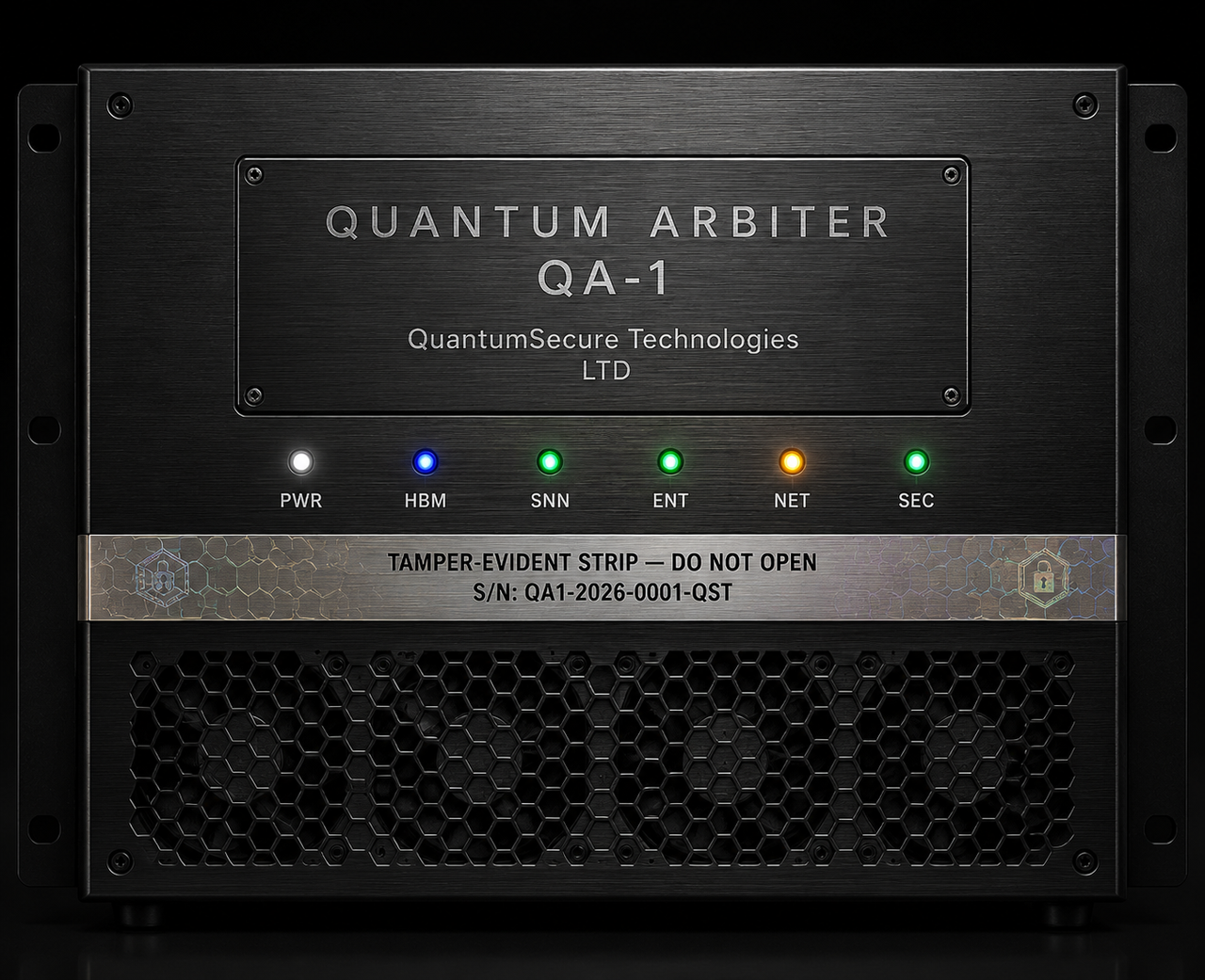
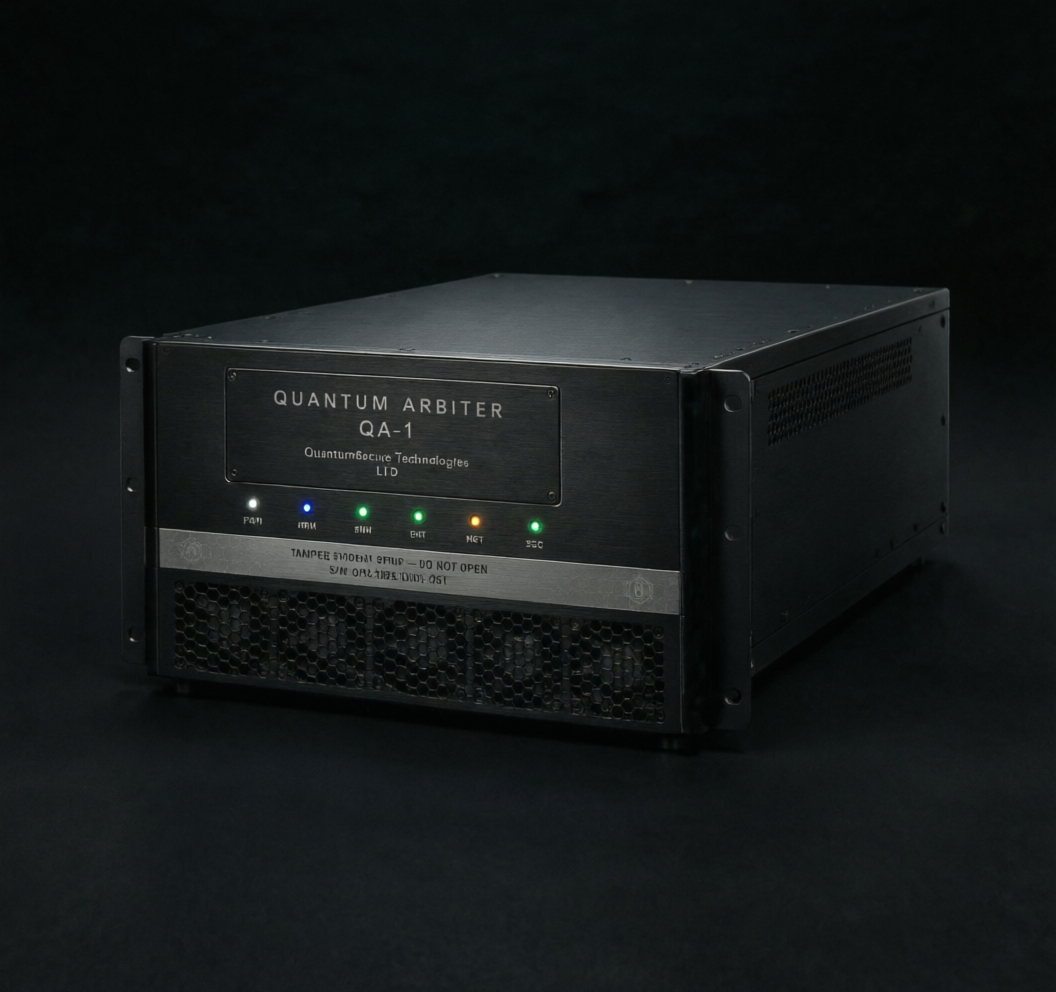
A self-contained 4U tower appliance that brings quantum-AI acceleration, neuromorphic optimisation, and post-quantum security into a single plug-and-play system.

Plug & Play
100GbE / InfiniBand
OpenQASM 3.0
Hardware-Ready
01 WHAT IT DOES

Three Ways to
Improve Quantum Workloads.

A sealed appliance for more efficient, more secure quantum workflows.

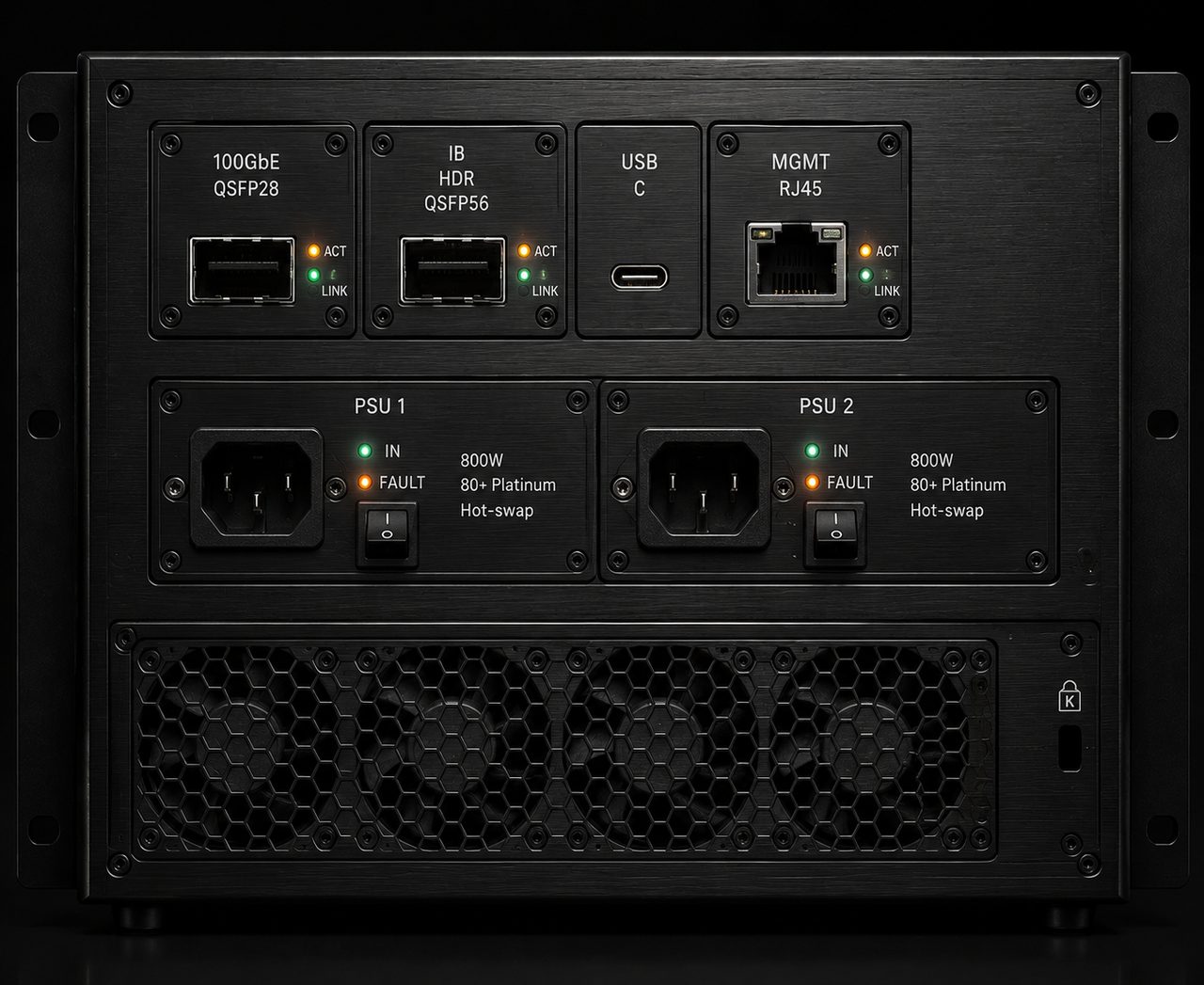
QA-1 connects to quantum processors over 100GbE or InfiniBand and accepts OpenQASM 3.0 circuits for optimisation before execution. It pre-emptively reduces circuit error by learning each processor's noise profile in real time, conditions quantum machine learning with on-card entropy, and protects IP through hardware-bound security controls.

The result is a system that helps vendors and research teams run more efficient, more secure quantum workflows without modifying the host QPU.

Interface
IN: OpenQASM 3.0
OUT: Optimised circuits
LINK: 100GbE / InfiniBand
OVERHEAD: <25 ms per iteration
INTEGRATION: ~100 lines of code
QPU CHANGES: None required
02 CORE CAPABILITIES

Pre-emptive. Entropy-Conditioned.
Hardware-Bound.

QA-1 Quantum Arbiter Coprocessor — Overview
/ 01

Pre-emptive Error Mitigation

The neuromorphic processor learns noise patterns such as crosstalk, T1/T2 drift, and readout error in real time, then compensates circuits before execution rather than correcting afterwards. This eliminates the 2–3× redundant runs that classical post-hoc mitigation requires.

/ 02

Entropy-Conditioned Quantum ML

The N1 card uses on-board physical entropy and conditioning pipelines to support uncertainty-aware quantum machine learning workloads. Real physical chaos flows through a three-stage pipeline into Bayesian neural networks for QKE, VQC, and QGAN training.

/ 03

Hardware-Bound IP Protection

Firmware, model weights, and signed outputs are locked to the security module and protected inside a tamper-evident enclosure. The host QPU vendor gets the benefit of the AI without ever seeing the AI.

03 SYSTEM ARCHITECTURE

Three Subsystems.
One Enclosure.

QA-1 combines a classical compute backbone, a neuromorphic processor, and a security module in a single sealed, tamper-evidenced 4U tower.

Subsystem Role Key Details
Classical Compute Backbone GPU-accelerated classical AI training and inference 2× NVIDIA L40S, AMD EPYC 9124, 256 GB DDR5, 4 TB NVMe
Neuromorphic Processor Circuit optimisation, entropy-based processing, pre-emptive error mitigation 2M LIF neurons, 500M synapses, 256 cores, <500 mW, 8 GB HBM2e, on-card entropy engine
Security Module Attestation, integrity enforcement, IP protection Post-quantum TPM, hardware root of trust, tamper mesh, firmware encryption

This architecture lets the system optimise circuits, return the improved version, and support iterative quantum machine learning workflows with minimal host-side integration.

QA-1 Quantum Arbiter Coprocessor — Architecture
04 INTEGRATION FLOW

Minimal Integration.
Maximum Impact.

01

Send Circuit

The host QPU sends OpenQASM 3.0 circuits to QA-1 over 100GbE or InfiniBand.

02

Optimise

QA-1 optimises the circuit and returns compilation statistics.

03

Sign & Return

All responses are cryptographically signed before returning to the host.

04

Execute

The host QPU executes the optimised circuit on its quantum hardware.

05

Feedback Loop

For VQC training, measurement results are fed back to QA-1 for gradient computation.

<25 ms
Overhead per iteration
~100
Lines of adapter code
Zero
QPU changes required
05 BUILT FOR DEPLOYMENT

Full Stack.
Already Implemented.

The complete software and firmware stack is implemented and ready for hardware integration — not early-stage development.

Firmware Modules
On-chip stack

Boot ROM, LIF neuron engine, STDP, spike router, DMA, entropy engine, QASM parser, health monitor

Linux Drivers
Kernel modules

PCIe, DMA, HBM, SNN, entropy, SPI, InfiniBand RDMA drivers

Windows Drivers
KMDF stack

Full Windows kernel-mode driver framework with INF files

User-Space Libraries
Multi-language

Python SDK, FastAPI REST interface, Rust crypto and entropy libraries

Documentation
Complete

Schematic reference, fabrication package, assembly package, integration test plan

Status
Hardware-Ready

Positioned for hardware integration and fabrication, not early-stage software development

06 TARGET USERS

Built for the Teams
Driving Quantum Forward.

User Use Case Benefit
Quantum Hardware Vendors Drop-in AI coprocessor for noisy quantum processors Better circuit performance through pre-emptive error mitigation
National Quantum Centres Quantum-AI research platform Entropy-conditioned ML training on real quantum noise
Cloud Providers Edge AI coprocessor at quantum data centres Per-QPU noise learning; premium enhanced service tier
Government & Defence Secure on-premises quantum computing Post-quantum security from day one; no data leaves facility
Pharma & Materials Science Quantum-accelerated molecular simulation Improved discovery workflows through circuit optimisation
07 COMMERCIAL OFFER

Four Configurations.
One Platform.

Research
£65,000

Hardware + open API for research teams

Professional
£120,000

Hardware + black-box API + full IP protection

Enterprise
£180,000

Hardware + API + IP protection + priority support

Government
£250,000+

FIPS 140-3 certified + classified deployment support

Annual License
£15,000/year

Firmware updates, model library, support (all SKUs)

Per-QPU Node
£5,000/year/QPU

License to connect one QPU to the QA-1

08 TIMELINE

Software Complete.
Hardware Critical Path.

The software phase is complete. The critical path is now hardware-only: fabrication, assembly, prototype testing, tapeout, integration, certification, and pilot deployment.

Months 1–2

PCB Fabrication

Send Gerber package; bare boards in 10–15 working days

Months 2–3

PCB Assembly

Contract manufacturer populates N1 cards; 2–3 week turnaround

Months 1–4

FPGA Proxy Validation

Validate SNN logic on FPGA proxy; deploy existing firmware (parallel with PCB)

Months 3–4

Prototype Testing

Power-on; run Level 0–1 tests; PCIe link, HBM, entropy, all rails

Months 3–5

ASIC Tapeout

Send validated RTL for fabrication (parallel with prototype testing)

Months 4–5

System Integration

Assemble first article; install components; firmware sealing; deploy software stack

Months 5–8

Integration Testing

Run all tests; entropy independence; SNN benchmarks; security; endurance

Months 5–10

Certification

FIPS 140-3, Common Criteria, NIST SP 800-90B, UKCA/CE/RoHS (parallel with testing)

Months 6–8

FPGA-Proxy Research Units

First revenue via Research configuration on FPGA proxy

Months 7–8

Pilot Deployment

First ASIC-based units at partner sites

Months 8–10

Commercial Launch

Full market availability across all configurations

QA-1 Quantum Arbiter Coprocessor — Detail
09 Contact

Request the technical brief.

info@quantumsecuretechnologies.co.uk
Home About Mission Cryptography Technology Aeon-Σ Chimera QC1 QA-1 Results Roadmap Journal Contact
Privacy Policy Terms & Conditions Cookie Policy
© 2026 QUANTUMSECURE TECHNOLOGIES LTD.
BIRMINGHAM, UK · INC. AUG 2025
Registered Company Name: QuantumSecure Technologies Ltd. | Registered Office Address: Birmingham, England, B18 4ND
Company Registration Number: 16627523 | Place of Registration: England and Wales

( Roadmap )

System
Status & Roadmap.

All systems are in R&D and pre-deployment. Below is our forward trajectory including the full Project Aeon-Σ quantum processing roadmap.

01 SYSTEM STATUS

Current Readiness.

NIST PQC Standards

In Development

Targeting NIST FIPS 203 (ML-KEM), FIPS 204 (ML-DSA), and FIPS 205 (SLH-DSA). Reference implementations under active development with KAT validation planned for Q3 2026.

Kyber-768 · Dilithium3

In Development

Primary key encapsulation and signature algorithm integration underway. 256-bit quantum security level targeted for initial internal benchmarks.

UK Silicon Sovereign

In Development

UK fabrication partnerships in negotiation. Target: 100% UK-designed chiplets with end-to-end auditable provenance. Pilot tape-out in planning.

FIPS 140-3

Pre-Application

Level 3 certification strategy documented. Hardware security module boundary design in progress. Formal submission targeted for Q1 2027.

02 PROJECT AEON-Σ

Aeon-Σ Roadmap.

Chaos-Stabilised Quantum Processing Unit. Technical de-risking, capital deployment gates, and the transition from foundational R&D to commercial IP licensing.

Phase 1 · Foundation

Foundation, Modelling & Supply Chain Qualification

+
1.1 · Theoretical Validation

Complete QuTiP simulations of the Skew Tent Map chaos protocol on a single transmon qubit, verifying the target Lyapunov exponent and decoherence suppression factors.

1.2 · Cryogenic FPGA Emulation

Build and validate a room-temperature and cryogenic FPGA emulation platform to test the Chaos Core, Q-MAC unit, and Octonion coprocessor logic in real-time.

1.3 · Supply Chain Lock-in

Contract and qualify all primary UK fabrication partners (e.g., NPL, Bay Photonics, NGI, RAL) to ensure 100% sovereign manufacturing.

1.4 · Advanced Material Fabrication

Initiate growth of critical exotic materials, including Bi₂Se₃ topological waveguides (via MBE), graphene aerogel fractal harvesters, and GaAs nanowire photodetectors.

Gate Review 1 · Go/No-Go

Capital allocation checkpoint to proceed to physical fabrication based on simulation and FPGA validation success.

Phase 2 · Fabrication

Fabrication & Component Calibration

+
2.1 · ASIC Tape-Out

Submit the design for the Aeon-Σ Control ASIC (22FDX cryo-CMOS) to the foundry, integrating the Chaos Core, Octonion Logic Coprocessor, and Lyapunov Horizon Monitor.

2.2 · Qubit Baseline Fabrication

Fabricate the first single-qubit Fano-plane transmon wafer and measure the baseline coherence time (T₁) without chaos stabilization enabled.

2.3 · Entropic Flow Subsystem Verification

Independently test the five core entropy-management components: Fractal Harvester (>40dB phononic bandgap), Optofluidic Sorter (bimodal frequency splitting, sub-ns feedback), and Landauer Sink (BEC formation, thermal diode rectification >10⁴).

2.4 · ASIC Cryogenic Characterisation

Receive the fabricated ASIC, package it, and verify it operates at 4K within strict power limits (≤150 mW) while maintaining chaotic stability.

Gate Review 2 · Go/No-Go

Checkpoint to proceed to full system integration, contingent on ASIC yield and subsystem verification.

Phase 3 · Proof of Concept

Single-Qubit Demonstration

+
3.1 · Stack Integration

Package the ASIC, bond it to the Nexus Q silicon interposer, and integrate it with a single Fano-plane qubit inside the dilution refrigerator.

3.2 · Baseline Measurement

Record the un-stabilized T₁ and T₂ coherence times to establish the control baseline.

3.3 · Chaos-ON Demonstration CRITICAL

Activate the Chaos Core, Optofluidic Sorter feedback loop, and Landauer Sink. Target: Demonstrate a ≥100× enhancement in T₁ coherence time (e.g., reaching ≥168 ms).

3.4 · Gate Fidelity Verification

Perform randomized benchmarking (RB) to ensure that the extended coherence translates to ultra-high single-qubit gate fidelity (Target: ≥99.994%).

Gate Review 3 · Go/No-Go

The ultimate technical validation gate. Success here proves the underlying physics and unlocks multi-qubit scaling.

Phase 4 · Scale-Up

Multi-Qubit Scaling & Commercial Testbed

+
4.1 · 7-Qubit Array Fabrication

Fabricate a full 7-qubit Fano-plane geometry array, leveraging the algebraic orthogonality of the Fano plane to intrinsically suppress crosstalk.

4.2 · Multi-Qubit Integration

Integrate the 7-qubit array with the full Aeon-Σ entropy management stack in the cryostat.

4.3 · Array Stabilization & Crosstalk Verification

Demonstrate that all 7 qubits maintain T₁ ≥ 100 ms simultaneously, with ≥20dB crosstalk suppression between non-coupled pairs.

4.4 · NQCC Testbed Deployment

Install the system at the National Quantum Computing Centre (NQCC). Launch the remote API, Python SDK, and live telemetry dashboard for independent verification.

4.5 · IP & Commercial Handover

Finalize the filing of the 15-family patent portfolio. Prepare technical collateral, integration guides, and licensing term sheets for quantum hardware manufacturers.

Gate Review 4 · Project Close

Final sign-off by the Independent Verifier and Project Board. Transition from R&D to commercialization.

Post-Phase 1 · Commercialization

Project Chimera — Scale-Up & Commercialization

+
C.1 · Neuromorphic Integration

Fabricate the Cortex Spiking Neural Network (SNN) ASIC and integrate it with the Vortex Entropy Fabric (VEF) on a shared interposer.

C.2 · 28-Qubit Compilation Demo

Use the SNN to compile and optimize quantum circuits in real-time at the 4K stage, demonstrating depth reduction on a scaled CS-QPU.

C.3 · 64-Qubit Logical Demonstrator

Scale the chaos-stabilized architecture to achieve a fault-tolerant logical error rate of <10⁻⁹.

C.4 · Commercial Licensing Launch

Execute platform licenses with major quantum hardware OEMs and launch Quantum-as-a-Service (QaaS) cloud access.

03 PRODUCT ROADMAP

Forward Trajectory.

Q2 2026 · Planned

NeuralSeal v3.2 Fulminis · Alpha

Initial alpha build of post-quantum cryptographic library in C11. Pure quaternion-chaos architecture. AVX-512 optimised. Early partner evaluation programme.

Q3 2026 · Planned

Synapse DevKit · Alpha

First developer kits for the Synapse composable chiplet platform. Includes 5 foundational chiplets, hardened Windows driver stack, and benchmark SDK.

Q4 2026 · Planned

HyperCycle v3.0 Multiverse

Quantum-entangled mesh networking. Distributed entropy generation across multiple nodes. Homomorphic encryption integration with zero-knowledge proof support.

Q1 2027 · Planned

Cortex Neuromorphic · Sampling

First silicon of the Cortex Neuromorphic Processor. 2M asynchronous spiking neurons. Sub-500mW always-on TDP. Qualified partner evaluation programmes.

Ongoing · Active R&D

HyperSilicon · IP Licensing

FPGA/ASIC IP core licensing programme. Hardware-accelerated Hamiltonian evolution engines. FIPS 140-3 Level 3 certification. Custom silicon co-design partnerships with defence primes and critical national infrastructure operators.

04 STANDARDS & CERTIFICATION

Compliance Milestones.

NIST PQC Standards · Target Q3 2026

FIPS 203 (ML-KEM), FIPS 204 (ML-DSA), FIPS 205 (SLH-DSA). Known Answer Tests in preparation. Interoperability testing with Open Quantum Safe project planned.

FIPS 140-3 Level 3 · Target Q4 2026

Physical tamper-evident boundary for NeuralSeal cryptographic module. Role-based authentication and identity-based operator authentication.

Common Criteria EAL 4+ · Target Q2 2027

Methodically designed, tested, and reviewed. Applicable where moderate to high independently assured security is required.

UK NCSC CPA · Target Q3 2027

Commercial Product Assurance certification from the UK National Cyber Security Centre. For government and critical national infrastructure deployments.

Home About Mission Cryptography Technology Aeon-Σ Chimera QC1 QA-1 Results Roadmap Journal Contact
Privacy Policy Terms & Conditions Cookie Policy
© 2026 QUANTUMSECURE TECHNOLOGIES LTD.
BIRMINGHAM, UK · INC. AUG 2025
Registered Company Name: QuantumSecure Technologies Ltd. | Registered Office Address: Birmingham, England, B18 4ND
Company Registration Number: 16627523 | Place of Registration: England and Wales
Secure Document Viewer // Level 5 Clearance
Index
Executive Statement 1. Introduction 2. Threat Landscape 3. Digital Immune System 4. Cryptographic Foundations 5. NeuralSeal Stack 6. HyperCycle Ecosystem 7. NeuralMESH Blockchain 8. Immune System Client 9. Invisible Guard and NGASM 10. Neuromorphic Computing 11. Fusion and QuantumSuite 12. Architecture Examples 13. Benchmarks 14. Conclusion

QuantumSecure Technologies Digital Immune System and Quantum-Ready Ecosystem

Prepared by Matthew Stennett

QuantumSecure Technologies LTD

www.quantumsecuretechnologies.co.uk

April 8, 2026

Executive Statement

QuantumSecure Technologies is building a Digital Immune System for the quantum era, replacing fragile, bolt-on security with a vertically integrated stack that defends quietly by default across cryptography, infrastructure, hardware, and software.

At its core, the ecosystem combines chaos- and physics-based post-quantum cryptography (Neural Seal and HyperCycle), a quantum-resistant, AI-powered Layer-1 blockchain (NeuralMESH), and a three-key, AI-guarded wallet (Immune System Client) that turns the user's wallet into an active security agent rather than a single point of failure.

Ambient enforcement and enterprise-grade protection are delivered through Invisible Guard and the Next-Generation Adaptive Security Mesh (NGASM), which apply homomorphic encryption, zero-knowledge proofs, and federated learning to detect and contain threats in real time across distributed networks.

1. Introduction

QuantumSecure Technologies (QST) is a UK-based cyber-security company focused on building the security substrate for the next computing era, where quantum-capable adversaries, AI-driven attacks, and neuromorphic computing fundamentally reshape the threat model.

Modern digital infrastructure rests on fragile assumptions: that users, devices, and software are trustworthy by default; that classical cryptography will hold indefinitely; and that breaches are exceptional rather than expected events.

QST's answer is the Digital Immune System (DIS) a vertically integrated ecosystem of post-quantum cryptography, self-defending networks, ambient enforcement, neuromorphic hardware, and secure-by-design programming tools designed to behave like a biological immune system for the digital world.

2. Threat Landscape and Motivation

2.1 The End of Implicit Trust

Legacy systems assume that cryptographic primitives remain unbroken, that software executes in largely benign environments, and that identities are not routinely stolen or forged. These assumptions are failing under the combined pressure of AI-augmented attackers, quantum computing research, and supply-chain vulnerabilities.

2.2 Harvest-Now, Decrypt-Later

Quantum-capable adversaries do not need to break encryption today; they can capture encrypted traffic and stored data now and decrypt it later once capable quantum hardware is available. Any long-lived secrets are at risk if protected by classical schemes alone.

3. Digital Immune System Architecture

3.1 Biological Analogy

The Digital Immune System draws explicit inspiration from biology, where the immune system observes patterns, tolerates normal variance, and escalates only when something deviates from "self". DIS mirrors this behaviour through three conceptual layers: Innate Defence, Adaptive Defence, and Memory and Regulation.

3.2 Core Values

  • Privacy by Design — Minimal exposure by default; zero-knowledge proofs and encrypted telemetry.
  • Intelligent Defence — AI-native security that evolves with threats via federated learning.
  • Decentralised Trust — No central authority must be blindly trusted.
  • Accessible Protection — Enterprise-grade defences deployable by individuals and small organisations.
  • Security as a Right — Strong security and privacy should be a default property of digital systems.

4. Cryptographic Foundations

4.1 Chaos Quaternion Cryptography (CQC)

Neural Seal's cryptographic foundation is Chaos Quaternion Cryptography (CQC), which combines quaternion algebra with chaos theory to construct hard problems believed to be resistant to both classical and quantum attacks.

4.2 Physics-Based Entropy

HyperCycle takes a complementary approach, using simulations of the quantum vacuum based on the Heisenberg-Euler Lagrangian to derive entropy and combining it with octonion algebra and chaos theory.

5. NeuralSeal Cryptographic Stack

NeuralSeal's stack is composed of five libraries: CQC Core (mathematical foundation), Weave-KEM (native KEM), Weave-DSA (native signature scheme), ML-KEM (compatibility layer), and ML-DSA (compatibility layer).

Benchmark and key-size comparisons show NeuralSeal v3.2 uses 256-byte public keys and 512-byte secret keys versus 1,568- and 3,168-byte keys for ML-KEM-1024. Latency for key generation and encapsulation ranges from ~0.24-0.47 µs.

6. HyperCycle Ecosystem

6.1 Architectural Evolution

  • Genesis (v1.0) — Demonstrates Hamiltonian dynamics for cryptographically secure entropy.
  • Origin (v1.1) — Introduces Octonion Geometric Algebra (O-GA-KEM) and universal GPU backend.
  • Vortex (v2.0) — Adds skew-tent-map-based chaos engines and zero-latency entropy reservoirs.

7. NeuralMESH Blockchain

NeuralMESH's consensus layer combines Tendermint, Raft, PBFT, and future quantum-enhanced protocols under a Multi-Consensus Orchestration framework. A controller monitors latency, throughput, fault patterns, and trust metrics to dynamically select the most appropriate consensus algorithm.

At Layer 5 (Privacy Framework), NeuralMESH integrates multiple ZK systems Groth16, PLONK, STARKS alongside homomorphic encryption (TFHE, BGV, CKKS) and secure MPC protocols.

8. NeuralMESH Wallet (Immune System Client)

The NeuralMESH Wallet directly addresses traditional wallet weaknesses by replacing the single key with a structured three-key model (Active, Standby, Recovery), providing instant network-wide revocation of compromised keys, enforcing PQC from day one, and integrating an AI daemon that behaves like an immune cell.

9. Invisible Guard and NGASM

Invisible Guard operates as an always-on guardian that monitors system behaviour using FHE, ZK proofs, and advanced analytics, without directly exposing sensitive data. NGASM extends the ambient defence concept into an enterprise-wide mesh that coordinates multiple sites, networks, and cloud environments.

10. Neuromorphic Computing

NeuroSync encapsulates neuromorphic algorithms that implement biologically inspired learning and inference at extremely low power budgets. The Synapse laptop integrates high-performance CPU/GPU components with a neuromorphic processor and a rich security silicon substrate. Guardian OS uses Synapse's neuromorphic hardware to implement a biological anomaly detection system (BADS).

11. Fusion Programming Language and QuantumSuite SDK

Fusion provides a cohesive programming model for building secure, quantum-ready applications with Python-like ergonomics, security annotations, and an entropic borrow checker. The QuantumSuite SDK exposes NeuralSeal, HyperCycle, NeuralMESH, Invisible Guard, NGASM, and Synapse primitives to developers as a modular toolkit.

12. End-to-End Architecture Examples

12.1 Secure Financial Transaction Flow

A representative flow for a regulated financial transaction in the DIS: user authenticates to NeuralMESH Wallet on a Synapse device; wallet constructs a shielded transaction with PQC for key exchange and signatures; transaction is broadcast over NeuralMESH via mTLS; NeuralMESH validates and records on the ledger.

12.2 Critical Infrastructure Control Flow

Control commands are signed with NeuralSeal or HyperCycle keys and sent over PQC-secured channels. Guardian OS and BADS monitor local system behaviour; NGASM aggregates encrypted telemetry across sites and applies federated learning.

13. Benchmarks and Capacity Planning

  • NeuralSeal v3.2 Fulminis: ≈0.47 µs keygen, 0.30 µs encaps, 0.22 µs decaps, millions of ops/sec on CPU, >1B ops/sec on GPU.
  • HyperCycle Vortex v2.0: 0.080 µs CPU operations, 0.010 µs AVX-512 batch, 0.00095 µs CUDA batch at 1.05B+ ops/sec.
  • NGASM: 900-3600× faster breach detection and response than traditional stacks.
  • NeuroSync: Real-time neuromorphic inference at less than 1 W power.

14. Conclusion and Roadmap

QST is constructing a comprehensive Digital Immune System that spans cryptography, blockchains, wallets, ambient security meshes, neuromorphic hardware, operating systems, and programming languages, all aligned around post-quantum, zero-trust, and privacy-by-design principles.

Future work includes deeper integration of FHE into NeuralMESH, broader deployment of HyperCycle entropy engines, expansion of NGASM's federated intelligence networks, deployment of an AI marketplace on NeuralMESH, and mainstream adoption of neuromorphic computing in consumer devices.

Legal

Privacy
Policy.

Last updated: 16 July 2026

1. Introduction

QuantumSecure Technologies Ltd ("we", "us", or "our") is committed to protecting your privacy. This Privacy Policy explains how we collect, use, disclose, and safeguard your information when you visit our website and use our services.

We are registered in England and Wales (Company Number 16627523) with our registered office at Birmingham, England, B18 4ND. For data protection purposes, we are the data controller.

2. Information We Collect

We may collect the following categories of personal data:

  • Contact Information: Name, email address, and organisation details submitted via our contact form.
  • Technical Data: IP address, browser type and version, operating system, and device identifiers collected automatically through server logs and analytics.
  • Usage Data: Pages visited, time spent on pages, navigation patterns, and interaction data collected through cookies and similar technologies.
  • Communication Data: Any information you provide when contacting us via email, form, or other channels.

3. How We Use Your Information

We process your personal data for the following purposes:

  • To respond to your enquiries and provide requested information about our products and services.
  • To monitor and improve website performance, security, and user experience.
  • To comply with legal obligations and regulatory requirements.
  • To communicate with you about product updates, security advisories, and other relevant information where you have consented to receive such communications.

4. Legal Basis for Processing

Under the UK General Data Protection Regulation (UK GDPR), we process your data based on:

  • Consent: Where you have given explicit consent for specific processing activities.
  • Legitimate Interest: Where processing is necessary for our legitimate business interests, such as improving our website and services.
  • Contractual Necessity: Where processing is necessary to fulfil a contract with you or take pre-contractual steps at your request.
  • Legal Obligation: Where we are required to process data to comply with applicable laws.

5. Data Retention

We retain your personal data only for as long as necessary to fulfil the purposes for which it was collected, or as required by law. Contact form submissions are retained for up to 24 months. Server logs are retained for up to 90 days. Analytics data is retained in aggregated, anonymised form.

6. Data Sharing

We do not sell your personal data. We may share your data with:

  • Service Providers: Trusted third parties who assist in operating our website (e.g., Netlify for hosting), subject to appropriate data processing agreements.
  • Legal Authorities: Where required by law, regulation, or legal process.
  • Business Transfers: In connection with any merger, acquisition, or sale of assets, subject to appropriate safeguards.

7. International Transfers

Your data may be transferred to and processed in countries outside the United Kingdom. Where this occurs, we ensure appropriate safeguards are in place, including Standard Contractual Clauses or equivalent mechanisms approved by the Information Commissioner's Office (ICO).

8. Your Rights

Under UK data protection law, you have the right to:

  • Access the personal data we hold about you.
  • Request correction of inaccurate data.
  • Request deletion of your data ("right to be forgotten").
  • Object to or restrict processing of your data.
  • Data portability — receive your data in a structured, machine-readable format.
  • Withdraw consent at any time where processing is based on consent.
  • Lodge a complaint with the Information Commissioner's Office (ICO).

9. Security

We implement appropriate technical and organisational measures to protect your personal data against unauthorised access, alteration, disclosure, or destruction. These measures include encryption, access controls, regular security assessments, and adherence to post-quantum cryptographic standards.

10. Contact Us

If you have any questions about this Privacy Policy or wish to exercise your data protection rights, please contact us at:

QuantumSecure Technologies Ltd
Registered Office: Birmingham, England, B18 4ND
Email: info@quantumsecuretechnologies.co.uk


Home About Mission Cryptography Technology Aeon-Σ Chimera QC1 QA-1 Results Roadmap Journal Contact
Privacy Policy Terms & Conditions Cookie Policy
© 2026 QUANTUMSECURE TECHNOLOGIES LTD.
BIRMINGHAM, UK · INC. AUG 2025
Registered Company Name: QuantumSecure Technologies Ltd. | Registered Office Address: Birmingham, England, B18 4ND
Company Registration Number: 16627523 | Place of Registration: England and Wales

Legal

Terms &
Conditions.

Last updated: 16 July 2026

1. Acceptance of Terms

By accessing or using the QuantumSecure Technologies Ltd website and services, you agree to be bound by these Terms and Conditions. If you do not agree to these terms, you must not use our website or services.

These terms constitute a legally binding agreement between you ("User", "you") and QuantumSecure Technologies Ltd ("we", "us", "our"), a company registered in England and Wales (Company Number 16627523) with its registered office at Birmingham, England, B18 4ND.

2. Intellectual Property

All content on this website, including but not limited to text, graphics, logos, icons, images, data compilations, software, and documentation, is the property of QuantumSecure Technologies Ltd or its licensors and is protected by United Kingdom and international intellectual property laws.

You may not reproduce, distribute, modify, create derivative works of, publicly display, publicly perform, republish, download, store, or transmit any material from this website without our prior written consent, except as expressly permitted by applicable law.

3. Permitted Use

You are granted a limited, non-exclusive, revocable licence to access and use the website for personal, non-commercial purposes. This licence does not include:

  • Any commercial use of the website or its content.
  • Data mining, robots, scraping, or similar data gathering tools.
  • Reproduction, duplication, or copying of content for commercial purposes.
  • Modification of any portion of the website.
  • Use of the website to compete with us or for any unauthorised purpose.

4. User Submissions

When you submit information through our contact form or other communication channels, you represent that:

  • The information is accurate and complete.
  • You have the legal right to provide such information.
  • Your submission does not violate any applicable law or regulation.

We reserve the right to refuse or remove any submission that, in our sole discretion, violates these terms or is otherwise objectionable.

5. Limitation of Liability

To the maximum extent permitted by applicable law, QuantumSecure Technologies Ltd shall not be liable for any indirect, incidental, special, consequential, or punitive damages arising out of or related to your use of the website or services.

Our total aggregate liability for any claims arising from or related to the website or services shall not exceed the amount you have paid to us in the twelve (12) months preceding the claim, or GBP 100, whichever is greater.

The website and its content are provided "as is" and "as available" without warranties of any kind, either express or implied, including but not limited to implied warranties of merchantability, fitness for a particular purpose, and non-infringement.

6. Indemnification

You agree to indemnify, defend, and hold harmless QuantumSecure Technologies Ltd, its directors, officers, employees, and agents from and against any claims, liabilities, damages, losses, and expenses (including reasonable legal fees) arising out of or related to your use of the website or violation of these terms.

7. Third-Party Links

This website may contain links to third-party websites or services. We do not endorse and are not responsible for the content, privacy policies, or practices of any third-party websites. Your use of third-party websites is at your own risk.

8. Governing Law

These Terms and Conditions are governed by and construed in accordance with the laws of England and Wales. Any disputes arising under or in connection with these terms shall be subject to the exclusive jurisdiction of the courts of England and Wales.

9. Changes to Terms

We reserve the right to modify these Terms and Conditions at any time. Changes will be effective upon posting to this page with an updated "Last updated" date. Your continued use of the website after any changes constitutes acceptance of the revised terms.

10. Contact

For questions regarding these Terms and Conditions, contact us at:

QuantumSecure Technologies Ltd
Registered Office: Birmingham, England, B18 4ND
Email: info@quantumsecuretechnologies.co.uk

Home About Mission Cryptography Technology Aeon-Σ Chimera QC1 QA-1 Results Roadmap Journal Contact
Privacy Policy Terms & Conditions Cookie Policy
© 2026 QUANTUMSECURE TECHNOLOGIES LTD.
BIRMINGHAM, UK · INC. AUG 2025
Registered Company Name: QuantumSecure Technologies Ltd. | Registered Office Address: Birmingham, England, B18 4ND
Company Registration Number: 16627523 | Place of Registration: England and Wales

Legal

Cookie
Policy.

Last updated: 16 July 2026

1. What Are Cookies

Cookies are small text files that are placed on your device when you visit a website. They are widely used to make websites work efficiently, provide a better user experience, and supply information to the site owners.

2. How We Use Cookies

We use cookies for the following purposes:

  • Strictly Necessary Cookies: Essential for the website to function correctly. These enable core features such as page navigation, smooth scrolling, and form submission.
  • Performance Cookies: Collect anonymised information about how visitors use our website, including which pages are visited most often and any error messages encountered.
  • Functionality Cookies: Remember your preferences and settings to provide a more personalised experience.
  • Analytics Cookies: Help us understand visitor behaviour through aggregated, anonymised analytics data.

3. Specific Cookies We Use

Cookie Purpose Duration
_ga / _gid Google Analytics — distinguishes unique users and tracks page views 2 years / 24 hours
_gat Google Analytics — throttles request rate 1 minute
lenis-scroll Stores scroll position for smooth scrolling library Session
netlify-lead-tracking Netlify form submission tracking Session

4. Third-Party Cookies

Some cookies are set by third-party services that appear on our pages. We do not control these third-party cookies. Key third-party services include:

  • Google Analytics: Provides anonymised website usage data. Google's privacy policy applies.
  • Netlify: Provides hosting and form handling.

5. Managing Cookies

You can control and manage cookies through your browser settings. Most browsers allow you to:

  • View and delete cookies.
  • Block all cookies or only third-party cookies.
  • Accept all cookies.
  • Set cookie preferences on a per-site basis.

Please note that disabling cookies may affect the functionality of this website.

6. UK Cookie Law Compliance

This Cookie Policy is issued in compliance with the UK Privacy and Electronic Communications Regulations (PECR) and the UK General Data Protection Regulation (UK GDPR), as enforced by the Information Commissioner's Office (ICO).

Under PECR, we are required to obtain your consent before setting non-essential cookies. By continuing to use this website, you consent to our use of cookies as described in this policy. You may withdraw your consent at any time by adjusting your browser settings or contacting us directly.

7. Changes to This Policy

We may update this Cookie Policy from time to time to reflect changes in technology, legislation, or our operational practices. Any changes will be posted on this page with an updated "Last updated" date.

8. Contact

If you have any questions about our use of cookies, please contact us at:

QuantumSecure Technologies Ltd
Registered Office: Birmingham, England, B18 4ND
Email: info@quantumsecuretechnologies.co.uk

Home About Mission Cryptography Technology Aeon-Σ Chimera QC1 QA-1 Results Roadmap Journal Contact
Privacy Policy Terms & Conditions Cookie Policy
© 2026 QUANTUMSECURE TECHNOLOGIES LTD.
BIRMINGHAM, UK · INC. AUG 2025
Registered Company Name: QuantumSecure Technologies Ltd. | Registered Office Address: Birmingham, England, B18 4ND
Company Registration Number: 16627523 | Place of Registration: England and Wales